The company announced a deep dive into generative AI with a suite of cloud-based technologies through AWS.
Amazon wants to become the Bedrock of artificial intelligence. The e-commerce giant just announced a proprietary set of core AI technologies that companies can use to build generative AI applications, much like Microsoft applies OpenAI's GPT-4 as a foundation of the new Bing Chat.
The program, called Amazon Bedrock, is a suite of foundation models (FM) that are part of Amazon Web Services (AWS) tools. It includes proprietary models, like Titan, as well as FM from AI21 Labs, Anthropic, and Stability AI.
"They're big large language models that you can build these generative AI experiences on top of and you just have to fine-tune them for what's specific about your applications", Amazon CEO Andy Jassy told CNBC. Generative AI is a form of artificial intelligence capable of creating new content, like images, text, and even videos and music.
As other tech companies join the generative AI trend that exploded with the launch of ChatGPT last November, like Google and Microsoft, Amazon is not one to be left behind. Bedrock could potentially benefit companies that want to launch their own generative AI applications but may not have the time and money to invest in them.
Through an API, companies that want to offer generative AI services will be able to work with and customize a foundation model to accelerate the development of these applications.
Amazon calls Bedrock a "serverless experience," as users can avail themselves of these new generative AI AWS tools without worrying about managing infrastructure.
The news comes after OpenAI's launch of its newest large language model, GPT-4, last month, and the growing popularity of generative AI tools which has triggered discussions of government regulations, as well as AI ethics and job market effects.
The biggest quality that sets AI aside from other computer science topics is the ability to easily automate tasks by employing machine learning, which lets computers learn from different experiences rather than being explicitly programmed to perform each task. This capability is what many refer to as AI, but machine learning is actually a subset of artificial intelligence.
Machine learning involves a system being trained on large amounts of data, so it can learn from mistakes, and recognize patterns in order to accurately make predictions and decisions, whether they've been exposed to the specific data or not.
Examples of machine learning include image and speech recognition, fraud protection, and more. One specific example is the image recognition system when users upload a photo to Facebook. The social media network can analyze the image and recognize faces, which leads to recommendations to tag different friends. With time and practice, the system hones this skill and learns to make more accurate recommendations.
What are the elements of machine learning?
As mentioned above, machine learning is a subset of AI and is generally split into two main categories: supervised, and unsupervised learning.
Supervised learning
This is a common technique for teaching AI systems by using many labelled examples that have been categorized by people. These machine-learning systems are fed huge amounts of data, which has been annotated to highlight the features of interest -- you're essentially teaching by example.
If you wanted to train a machine-learning model to recognize and differentiate images of circles and squares, you'd get started by gathering a large dataset of images of circles and squares in different contexts, such as a drawing of a planet for a circle, or a table for a square, for example, complete with labels for what each shape is.
The algorithm would then learn this labeled collection of images to distinguish the shapes and its characteristics, such as circles having no corners and squares having four equal sides. After it's trained on the dataset of images, the system will be able to see a new image and determine what shape it finds.
Unsupervised learning
In contrast, unsupervised learning uses a different approach, where algorithms try to identify patterns in data, looking for similarities that can be used to categorize that data.
An example might be clustering together fruits that weigh a similar amount or cars with a similar engine size.
The algorithm isn't set up in advance to pick out specific types of data; it simply looks for data with similarities that it can group, for example, grouping customers together based on shopping behavior to target them with personalized marketing campaigns.
Reinforcement learning
In reinforcement learning, the system attempts to maximize a reward based on its input data, basically going through a process of trial and error until it arrives at the best possible outcome.
Consider training a system to play a video game, where it can receive a positive reward if it gets a higher score and a negative reward for a low score. The system learns to analyze the game and make moves, and then learns solely from the rewards it receives, reaching the point of being able to play on its own and earn a high score without human intervention.
Reinforcement learning is also used in research, where it can help teach autonomous robots about the optimal way to behave in real-world environments.
What are large language models?
One of the most renowned types of AI right now are large language models (LLM). These models use unsupervised machine learning and are trained on massive amounts of text to learn how human language works. These texts include articles, books, websites, and more.
In the training process, LLMs process billions of words and phrases to learn patterns and relationships between them, making the models able to generate human-like answers to prompts.
The most popular LLM is GPT 3.5, on which ChatGPT is based, and the largest LLM is GPT-4. Bard uses LaMDA, a LLM developed by Google, which is the second-largest LLM.
What is deep learning?
Part of the machine-learning family, deep learning involves training artificial neural networks with three or more layers to perform different tasks. These neural networks are expanded into sprawling networks with a large number of deep layers that are trained using massive amounts of data.
Deep-learning models tend to have more than three layers, and can have hundreds of layers. It can use supervised or unsupervised learning or a combination of both in the training process.
Because deep-learning technology can learn to recognize complex patterns in data using AI, it is often used in natural language processing (NLP), speech recognition, and image recognition.
If you want to know about the fascinating and fast-developing technologies of artificial intelligence, we cover everything from machine learning and general AI to neural networks.
What is artificial intelligence?
Hear the term artificial intelligence (AI) and you might think of self-driving cars, robots, ChatGPT or other AI chatbots, and artificially created images. But it's also important to look behind the outputs of AI and understand how the technology works and its impacts for this and future generations.
AI is a concept that has been around, formally, since the 1950s, when it was defined as a machine's ability to perform a task that would've previously required human intelligence. This is quite a broad definition and one that has been modified over decades of research and technological advancements.
When you consider assigning intelligence to a machine, such as a computer, it makes sense to start by defining the term 'intelligence' -- especially when you want to determine if an artificial system is truly deserving of it.
Our level of intelligence sets us apart from other living beings and is essential to the human experience. Some experts define intelligence as the ability to adapt, solve problems, plan, improvise in new situations, and learn new things.
With intelligence sometimes seen as the foundation for human experience, it's perhaps no surprise that we'd try and recreate it artificially in scientific endeavors.
And today's AI systems might demonstrate some traits of human intelligence, including learning, problem-solving, perception, and even a limited spectrum of creativity and social intelligence.
How can I use AI?
AI comes in different forms that have become widely available in everyday life. The smart speakers on your mantle with Alexa or Google voice assistant built-in are two great examples of AI. Other good examples are popular AI chatbots, such as ChatGPT, the new Bing Chat, and Google Bard.
When you ask ChatGPT for the capital of a country or you ask Alexa to give you an update on the weather, you'll get responses that are the result of machine-learning algorithms.
Though these systems aren't a replacement for human intelligence or social interaction, they have the ability to use their training to adapt and learn new skills for tasks that they weren't explicitly programmed to perform.
What are the different types of AI?
Artificial intelligence can be divided into three widely accepted subcategories: narrow AI, general AI, and super AI.
What is narrow AI?
Artificial narrow intelligence (ANI) is crucial to voice assistants, such as Siri, Alexa, and Google Assistant. This category includes intelligent systems that have been designed or trained to carry out specific tasks or solve particular problems, without being explicitly designed to do so.
ANI might often be referred to as weak AI, as it doesn't possess general intelligence, but some examples of the power of narrow AI include the above voice assistants, and also image-recognition systems, technologies that respond to simple customer service requests, and tools that flag inappropriate content online.
ChatGPT is an example of ANI, as it is programmed to perform a specific task, which is to generate text responses to the prompts it is given.
What is general AI?
Artificial general intelligence (AGI), also known as strong AI, is still a hypothetical concept as it involves a machine understanding and performing vastly different tasks based on its accumulated experience. This type of intelligence is more on the level of human intellect, as AGI systems would be able to reason and think like a human.
Like a human, AGI would potentially be able to understand any intellectual task, think abstractly, learn from its experiences, and use that knowledge to solve new problems. Essentially, we're talking about a system or machine capable of common sense, which is currently not achievable with any form of available AI.
Developing a system with its own consciousness is still, presumably, a fair way in the distance, but it is the ultimate goal in AI research.
What is super AI?
Artificial super intelligence (ASI) is a system that wouldn't only rock humankind to its core, but could also destroy it. If that sounds straight out of a science fiction novel, it's because it kind of is: ASI is a system where the intelligence of a machine surpasses all forms of human intelligence, in all aspects, and outperforms humans in every function.
An intelligent system that can learn and continuously improve itself is still a hypothetical concept. However, it's a system that, if applied effectively and ethically, could lead to extraordinary progress and achievements in medicine, technology, and more.
What are some recent examples of AI?
Overall, the most notable advancements in AI are the development and release of GPT 3.5 and GPT 4. But there have been many other revolutionary achievements in artificial intelligence -- too many, in fact, to include all of them here.
Here are some of the most notable:
ChatGPT (and the GPTs)
ChatGPT is an AI chatbot capable of natural language generation, translation, and answering questions. Though it's arguably the most popular AI tool, thanks to its widespread accessibility, OpenAI made significant waves in the world of artificial intelligence with the creation of GPTs 1, 2, and 3.
GPT stands for Generative Pre-trained Transformer, and GPT-3 was the largest language model in existence at the time of its 2020 launch, with 175 billion parameters. The latest version, GPT-4, accessible through ChatGPT Plus or Bing Chat, has one trillion parameters.
Self-driving cars
Though the safety of self-driving cars is a top concern of potential users, the technology continues to advance and improve with breakthroughs in AI. These vehicles use machine-learning algorithms to combine data from sensors and cameras to perceive their surroundings and determine the best course of action.
Tesla's autopilot feature in its electric vehicles is probably what most people think of when considering self-driving cars, but Waymo, from Google's parent company, Alphabet, makes autonomous rides, like a taxi without a taxi driver, in San Francisco, CA, and Phoenix, AZ.
Cruise is another robotaxi service, and auto companies like Apple, Audi, GM, and Ford are also presumably working on self-driving vehicle technology.
Robotics
The achievements of Boston Dynamics stand out in the area of AI and robotics. Though we're still a long way away from creating AI at the level of technology seen in the moive Terminator, watching Boston Dyanmics' robots use AI to navigate and respond to different terrains is impressive.
DeepMind
Google sister company DeepMind is an AI pioneer making strides toward the ultimate goal of artificial general intelligence (AGI). Though not there yet, the company initially made headlines in 2016 with AlphaGo, a system that beat a human professional Go player.
Since then, DeepMind has created a protein-folding prediction system, which can predict the complex 3D shapes of proteins, and it's developed programs that can diagnose eye diseases as effectively as the top doctors around the world.
National Technology Day is celebrated every year on May 11th, as a reminder to the world about India’s growing power in the field of science and technology. The day also serves as an opportunity to honor scientists and engineers who have made contributions to the nation’s development.
The National Technology Day has a different theme every year. For 2023, the theme is ‘School to Startups-Igniting Young Minds to Innovate’
Rahul S Kurkure, Founder and Director, Cloud.in Adopting a hybrid and multi-cloud approach is becoming a highly sought-after strategy as it offers organisations numerous benefits, including increased security and flexibility. AI and ML are today part of Cloud Services as it has become increasingly challenging for companies to build their own AI infrastructure. Additionally, containerized applications are gaining traction, which is further driving transformational technology trends in cloud computing. At Cloud.in, our team of experts possesses deep technological expertise and empowers organizations with a broad range of cloud solutions, making us a game-changer in the cloud offerings space. We believe that in the near future, cloud services will continue to be leveraged to access more innovative technologies, further enhancing the efficiency of business operations and customer experience. As a result, we strive to stay ahead of the curve by providing cutting-edge solutions to our clients.
Amazon says AWS Bedrock will provide access to multiple foundation AI models for enterprise-scale AI applications.
Amazon is the latest hyperscaler to take on the world of foundation AI including generative and large language models. It has launched a new platform called AWS Bedrock that includes access to in-house tools such as the Titan family of foundation models, and pre-trained models from start-ups like AI21 Labs, Anthropic and Stability AI. The company says the focus is on providing a range of models for use in “enterprise-scale” AI tools. One expert said Amazon has “a long way to go” to catch up with other players in the field.
Opening AWS up as a marketplace for multiple AI models mirrors moves by Google to offer those made by third parties in Google Cloud alongside its own PaLM, including from Midjourney and AI21 Labs. Microsoft has gone “all in” with OpenAI through its Azure cloud, offering GPT-4, ChatGPT and other models for customers.
Amazon says it will allow companies to train chatbots and AI tools on their own proprietary data without having to invest in costly data centres and expensive AI chips. AWS will use a combination of its own custom AI chips and those from Nvidia. “We’re able to land hundreds of thousands of these chips, as we need them,” explained Dave Brown, VP of Elastic Compute Cloud at AWS.
The launch of Bedrock has been in the works for the past few months, with AWS signing partnership agreements with Stability AI and other start-ups, as well as investing more in generative AI apps and its underlying technology. Hugging Face has also worked to bring its library of text-generating models onto AWS and Amazon has launched an AI accelerator for startups.
AWS is the largest hyperscaler in the world but is facing increasing competition from Google Cloud, Microsoft Azure and others, largely off the back of their AI offerings. Both companies have invested heavily in general AI tools including in chatbots such as ChatGPT and Google Bard.
Amazon hasn’t unveiled the pricing for its AI offerings yet and full details aren’t clear but users will be able to tap into the various foundation models via an API. It is focused on “enterprise-scale” apps rather than individual tools as it is designed for scale.
Multiple AI models
AI21 Labs Jurassic-2 family of foundation models are particularly suited to generating multilingual text, while Anthropic’s Claud is good for text-processing and conversational tools. Stability AI brings text-to-image tools to Bedrock including Stable Diffusion which can be used for images, art, logos and graphic design. The most recent version of Stable Diffusion has improved text accuracy and clarity. Using Bedrock, developers will be able to create tools that combine models.
Amazon’s own Titan models include text and embedding. This allows for text generation like writing a blog post or a sales pitch, where embedding can translate text into numerical representations to find the semantic meaning of the text.
Any of the models can then be further trained on labelled datasets stored in S3, Amazon’s cloud storage tool. Only 20 well-labelled pieces of data is required to make the model work against the proprietary information and none of that data will be used to train the underlying models, according to Amazon.
“At Amazon, we believe AI and ML are among the most transformational technologies of our time, capable of tackling some of humanity’s most challenging problems. That is why, for the last 25 years, Amazon has invested heavily in the development of AI and ML, infusing these capabilities into every business unit,” the company said in a statement.
In the same statement Amazon highlighted the use of chips to bring down the cost of running generative AI workloads, explaining that these ultra-large models require massive compute power to run in production and so AWS Inferentia chips can be used to make this more efficient and reduce cost at enterprise scale.
AWS Bedrock has ‘a lot of catching up to do’
The company is also opening up its answer to Microsoft’s GitHub Copilot, a tool widely used by developers to help write code. Amazon is making CodeWhisperer available for free for individual developers. It is an AI-powered coding companion that can offer code suggestions based on previously written code or comments. There are no usage limits for the free version, but a paid tier, for professional use, also includes enterprise security and admin capabilities.
Daniel Stodolsky, former Google Cloud VP and current SVP of Cloud at SambaNova said the old cloud argument of bringing compute to your data doesn’t stack up in the new world of generative AI. “Whereas other cloud services such as predictive analytics rely on huge volumes of real-time data, Amazon says the process of customising its pre-trained LLM can be completed with as few as 20 labelled data examples,” he said.
“The trend for generative AI will be towards open best-of-breed approaches rather than vendor lock-in and closed models. It’s much better to own a large language model that’s built and fine-tuned for your use-case rather than relying on an off-the-shelf model with minimal customisation.
“The other consideration is getting value from generative AI quickly. Amazon’s Bedrock service is only in limited preview right now and anyone looking at AWS Service Terms will find that Service Level Agreements don’t apply – in other words, it’s not production ready and won’t be for some time. Generative AI is a race that’s already well underway, and Amazon clearly has a lot of catching up to do with other production-ready platforms.”
The cloud allows you to scale to a level of computing, networking and storage that you could not otherwise achieve. It enables continuous innovation and ease of collaboration. But to achieve these benefits, it’s important to design your cloud solution with high availability, security and governance. In this blog, we explain how to achieve this with Google Cloud Platform.
While there may be specific circumstances in which it is advisable to opt for a hybrid cloud strategy, expert advice is increasingly focused on moving to public cloud. There are several reasons for pursuing a public cloud strategy including:
CapEx vs. OpEx. Cloud computing moves organizations from a CapEx (capital expenditure) model to an OpEx (operating expense) model, with OpEx offering low or no upfront costs, and tax deductible benefits. It also provides lower risk and exit costs.
Lower TCO(total cost of ownership). You save money as you don’t need to build out your own data center with all the ongoing associated maintenance and running costs.
Pay-as-you-go philosophy.Only pay for what you use, unlike an on-premise data center that requires overprovisioning, which means you pay for computing resources regardless of whether you use them.
Flexibility and agility. Public cloud makes it far easier to adapt your IT projects as needed, with almost immediate provisioning and the ability to scale up or down rapidly. Over and above these, CIOs want a solution that provides security and governance. To achieve this, it’s best to follow a proven methodology and to go slowly.
Designing a step-by-step Google Cloud strategy that delivers
At SoftwareOne, we follow a well-practiced step-by-step process to ensure all the benefits and requirements of a Google Cloud project are met.
Discover.We start by understanding what a customer’s business outcomes are and then establish the scope of the IT project to achieve these outcomes. We analyze the client's services and/or applications, evaluating their cloud maturity and various scenarios available to them. In this phase we carry out data collection, we interview the personnel involved (both IT and business), and then identify and group the infrastructures by dependencies.
Execution planning.Here we define the design and architecture model, following the standard and proven Google Cloud methodology. We determine what needs to move and how this can be moved. This could include computing, networking, storage, databases, serverless scenarios or containers. We prepare the landing zone, clarifying the aspects of identity management, networks, security and billing. And we prepare for the kickoff, specifying tasks and workflows.
Project start.We subdivide the project into the phases of adoption, migration, transformation and obtaining results. The plan designed in the previous phases is executed, always iteratively, and decisions and improvements are made based on the results of the ongoing analysis.
Optimize.Here we monitor and operate the migrated services and infrastructures, providing centralized management. We give advice on continuous improvement, through the study of new services and/or products, as well as advice for cost optimization and control of resources and billing.
What projects can be tackled with Google Cloud Platform?
Examples of projects we have done with customers are:
Workload migration
Transformation and modernization
Workstations virtualization
Datacenter extension
DRaaS, backup and continuity management
Microsoft Active Directory Managed Service
Remote and easy access for internal web applications with BeyondCorp
Virtualization based on VMware
For each scenario we apply a decision model that, after discovery and planning, consists of deciding whether to migrate (rehost or replatform) or change (refactor or rebuild). Then we enter a continuous cycle of improvement and optimization.
To undertake each project with customers, we have total flexibility to adapt to their needs. We provide turnkey projects, where scope, time and price are agreed up front; an agile model with an agreed bag of hours for development and maintenance; a baseline approach in which we provide skilled resources, consulting or training; or a combination of any of these depending on requirements.
As various high-profile fiascos have demonstrated, getting your data house in order, building guardrails and winning trust are key to effective artificial intelligence deployments
When top OpenAI investor Microsoft unleashed a ChatGPT-infused Bing search on the world, it wasn’t long before it ran haywire, comparing journalists to Hitler and gaslighting its users. Of course, these deranged tirades were not really an AI going rogue or anything of that sci-fi ilk; the tool is a probabilistic program that, having scraped the internet and all the junk on it as its source, returns answers that it thinks are likely to be correct. The whole episode did, however, highlight the need for a considered approach to AI deployments, especially when they’re public-facing. Above all, it demonstrated that AI needs precise use cases informed by good, up-to-date data, and guardrails to ensure it’s on the right track.
“Microsoft, Bing, OpenAI and ChatGPT have done the world a favour,” comments EMEA field CTO at Databricks, Dael Williamson, “because on the one hand, they’ve shown us the art of the possible – but they’ve also shown us the respect we have to give to training data.”
As amusing as the headline-grabbing antics of abusive chatbots might be, what will really be front of mind for most businesses as they seek to leverage artificial intelligence is how it can help them work smarter and more efficiently. For example, Williamson saw the power of AI in his previous career in proteomics, with simulations for drug discovery that used to take 25 days now taking just a few hours. And across all kinds of industries, businesses are using AI in ways that might not make headlines but are helping them provide better solutions and services. Whether we’re aware of it or not, many of us interact with AI on a daily basis – from the navigation tools that plot courses for Uber to Amazon’s recommendation engines.
“It all starts with data,” says Williamson. “Before businesses can create AI models that actually deliver value, they need to ensure the source data they’re building from is accurate, complete, timely and fair.”
While the transformational potential of AI really is enormous, and may change the world in unforeseen ways, most businesses will be seeking to use AI to improve their business processes. Decision-makers have certainly noted the potential. In a recent MIT and Databricks technology review survey, CIOs estimated that AI spending over the next three years will increase in security by 101%, data governance by 85% and new data and AI platforms by 69%. To ensure that it’s AI driving the efficiencies rather than a tail wagging the dog situation where the technology is in search of a problem, businesses will need to first identify the use cases that would actually benefit from these rollouts and, crucially, ensure their data is in order.
Artificial intelligence is only as good as the data that feeds it. Unfortunately for weary data scientists, who spend an astonishing 80% of their time searching for the stuff, most organisations are sitting on incredible treasure troves of data, but it’s scattered and hard to find. This is unsurprisingly a barrier to using it effectively, let alone for building effective AI models.
If not hidden down the proverbial sofa, this data is siloed, disconnected and sorted in different databases and formats. In short, staff in department A may not know about the data in department B, and even if they do, they’d struggle to connect it. To get around this, businesses need to unify their data environment. “We call it the ‘lakehouse’ concept – think of it as the production and distribution of data and models,” says Williamson of this open architecture proposal, “where it covers all the value units you’d typically want to have your data go through.”
By unifying all of your business data and applying governance to it, the data becomes much more observable, making it easier to maintain and manage data integrity. With this data organised, accessible and standardised, businesses can pick and choose which data sets are the most appropriate for the model they’re building, whether that’s large language models, computational models, deep or machine learning, and then build the applications on top of that.
“That’s the technology, but the hard bit is change management and trust,” says Williamson. No wonder; those aforementioned fearful headlines often frame artificial intelligence as a uniquely disruptive force that’s set to play havoc with society as we know it, shredding the social contract and discarding its hapless victims. That’s not the case at all – most businesses will simply be attempting to drive efficiencies, using automation to sluice away the most dreary manual tasks, which often don’t scale without a little technological assistance.
Take the humble elevator, for example, notes Williamson. For many years, lifts were staffed by an attendant, greeting users and pulling the levers. It took a long while before people trusted these newfangled automated contraptions enough to press a button, but now it’s as intuitive as crossing the road. Change can take time, and that’s why it’s so vital organisations manage it carefully, rolling out AI deployments with openness and transparency. At the very least, they should work with technology that operates a sort of “glass box” model – as opposed to an opaque “black box” with all the inner workings hidden away – so that users understand exactly what is going on and why.
“If you translate it to people, process and technology, technology needs to be simplified and made uncomplicated, while process is the real ‘unlock’ to create efficiency, build trust and transparency through that,” says Williamson.
Today, it’s really only the dawn of the AI era, but soon enough it’ll become evident that people will largely interact with machines as co-pilots, much the same as other transformative technologies like the printing press and the internet. Communicating this to users is key: “We need transparency, open data and trust,” Williamson says, with projects that demonstrate their value to staff outside of data science functions. “The few enable the many – that’s the bottom-up way of thinking about it. There also has to be a top-down commitment from the C-suite and all business leaders to work together; a partnership between those two groups, where everyone is rowing in the same direction.”
Our everyday tasks are increasingly digital, supported by tools and services that are based on some remote server farm. How do we assess the carbon footprint left by data centers?
It's hard to function in modern life without the 'cloud'. Our everyday tasks are increasingly digital, supported by tools and services that are based on some remote server farm. The cloud, after all, is just someone else's computer (or server).
Now it's certainly the case that the cloud helps enable a fairly low-carbon footprint, allowing people to accomplish a lot without burning fuel to get anywhere, like working from home or navigating more efficiently to avoid traffic jams. At the same time, it's easy to forget that the cloud has its own carbon footprint, left by data centers buzzing with digital activity.
"At the end of the day, the internet is running on data centers, and from an operational perspective, the data centers are running on energy," Maud Texier, Google's head of clean energy and carbon development, tells ZDNET. "So, this is the primary source of greenhouse gas emissions -- when someone is using the cloud, is typing an email and creating something new."
Before attempting to determine how green the cloud is, it's worth revisiting just what exactly the 'cloud' is. This somewhat cryptic tech term simply refers to computing services delivered over the internet. That definition covers everything from applications like Instagram or Google Search to foundational computing services like processing power and data storage. Companies can decide to manage their digital operations on their own servers (typically in an on-premises data center) or via a cloud provider like Google Cloud, Amazon Web Services or Microsoft Azure.
More data doesn't equal more energy consumption
Given the way the digital economy has exploded over the past two decades, it'd be easy to assume that the cloud's carbon footprint has also spiked. Luckily, that's not the case.
Research published in 2020 found that the computing output of data centers increased 550% between 2010 and 2018. However, energy consumption from those data centers grew just 6%. As of 2018, data centers consumed about 1% of the world's electricity output.
The tech industry has managed to keep its energy consumption requirements in check by making huge energy efficiency improvements, as well as taking a range of other strategic moves.
Cloud vs data centers
Cloud migration has been huge -- the share of corporate data in the cloud jumped from 30% in 2015 to 60% in 2022.
But mostly organizations aren't moving to make their operations more sustainable, notes Miguel Angel Borrega, research director for Gartner's infrastructure cloud strategies team.
"There are other variables that are even more important than sustainability," he says to ZDNET -- such as cost savings or the ability to leverage the latest technologies from cutting-edge innovators like Google and Microsoft. That said, sustainability ends up as a clear benefit as well.
"When we compare gas emissions, energy efficiency, water efficiency, and the way they efficiently use IT infrastructure, we realize that it's better to go to the cloud," Borrega says.
One major reason service providers could run more efficiently, he says, is simply that their infrastructure is newer and more efficient. Many existing corporate data centers are 30 or 40 years old, meaning they aren't taking advantage of more recent gains in energy efficiency.
Renewable energy
One of the main drivers for reducing greenhouse gas emissions is using renewable sources of energy. Traditional data centers are normally powered with energy from fossil fuel sources, but new cloud regions are increasingly tapping renewables.
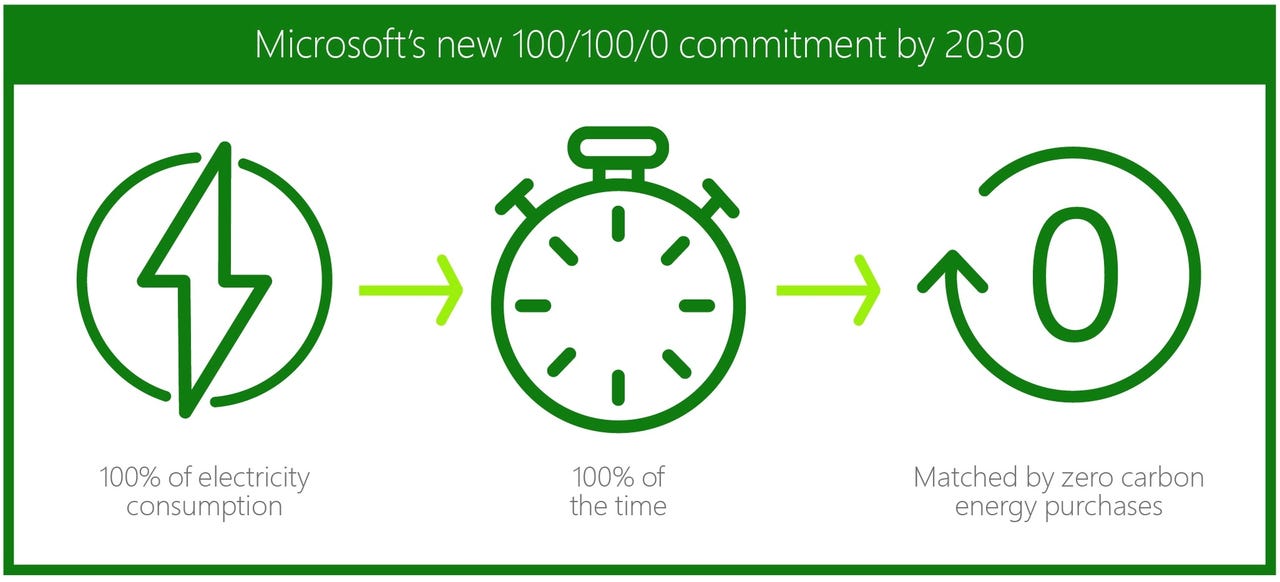
In cases where they can't use renewables, cloud companies are now often committed to compensating for their energy use with zero-carbon energy purchases, or carbon credits -- effectively investing in future carbon-free uses. For example, Microsoft has pledged to have 100% of its electricity consumption matched by zero-carbon energy purchases by 2030.
Source: Microsoft
"Like other users, our datacenters and our offices around the world simply plug into the local grid, consuming energy from a vast pool of electrons generated from near and far, from a wide variety of sources," Microsoft executives wrote at the time. "So while we can't control how our energy is made, we can influence the way that we purchase our energy."
Amazon, meanwhile, says it's on trajectory to power all of its operations with 100% renewable energy by 2025. That includes Amazon's operations facilities, corporate offices, physical stores as well as Amazon Web Services (AWS) data centers. It says it's committed to reaching net-zero carbon across its operations by 2040.
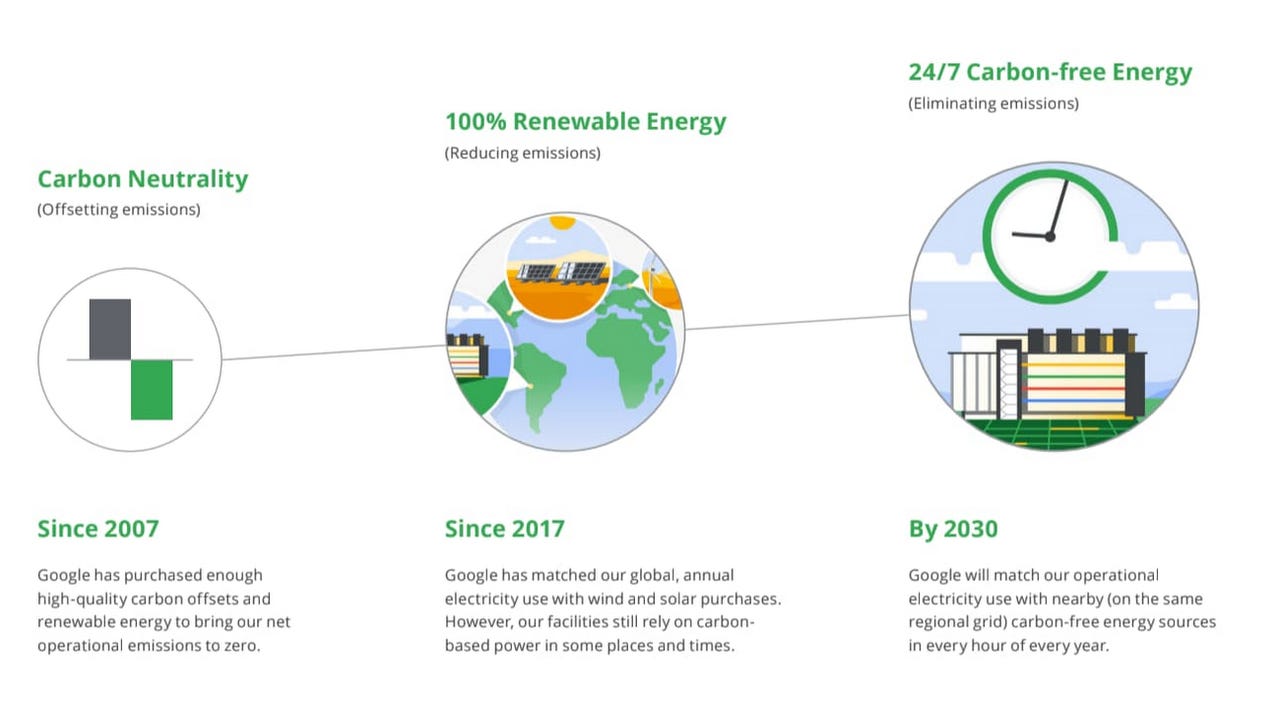
Google started its cloud sustainability efforts in 2007 by purchasing high-quality carbon credits. In 2010, it began finding clean energy sources and adding clean energy to the grid to compensate for its consumption. And since 2017, the company has been buying enough renewable energy to match its consumption.
Source: Google
In 2020, Google began tracking a new metric, the carbon-free energy percentage (CFE%). This metric represents the average percentage of carbon-free energy consumed in a particular location on an hourly basis, while taking into account the carbon-free energy that Google has added to the grid in that particular location. So for businesses, the CFE% represents the average percentage of time their applications will be running on carbon-free energy.
Google also set a goal in 2020 to match its energy consumption with carbon-free energy (CFE), every hour and in every region by 2030. As of last year, Texier says about two-thirds of Google's energy consumption relied on CFE.
Source: Google
"There's still more work to do," she says. "It's going to be much more regional -- how do we talk with regional stakeholders and utilities as they try to change the grids?"
Where is your cloud running?
Location is an important aspect to consider for anyone trying to assess just how 'green' a specific cloud is, as Trexier suggests. Some of Google's data centers, in places such as Finland, Toronto and Iowa, have a CFE% above 90. Others, such as data centers in Singapore, Jakarta and South Carolina, are closer to 10% or 20%.
"This is one of the biggest realizations that came to us when we switched from this global annual goal to this small, more specific, 24/7 goal," she says. "That actually, there's a very large variability within the portfolio. And we have to be much more surgical in terms of the roadmap for each data center."
In places such as the Asia Pacific region, Texier says the barriers to greater renewables adoption are often geographical -- there's just not a lot of space to create renewable energy. Instead, energy providers have to build "islanded grids" that provide energy from sources such as offshore wind, which is more expensive and built on newer technologies.
Meanwhile, in places like the US South, Texier says there are fewer options for energy customers like Google to purchase green energy.
"Big picture right now, there's a lot of demand for renewable energy, not just from Google, but from a lot of corporations," she says.
"It's really been a booming market, which on one side is is really helpful to accelerate the deployment of more renewable energy. On the other side, what we are realizing now is that the needs of deployment of clean energy and renewable energy cannot be met with the current processes that we have."
Getting more efficient
While cloud providers work with the energy sector and regulators to create more renewable energy options, they're also getting more efficient at running their operations. A data center requires a great deal of power to run workloads, maintain data storage, run cooling systems, distribute energy, and so forth. With advances in areas such as refrigeration and cooling systems, cloud providers can dedicate more energy to providing computing power.
At the same time, cloud providers can offer efficient server utilization.
"Imagine you have a server that can support 100 workloads," Borrega says. "Normally what we see is that to run this basic volume of workloads, on average [data centers] use only 40% of their computing resources. But we are powering it with all the energy to support this potential functionality. So in data centers, normally IT infrastructure is used on average at 40%. When we move to cloud providers, the rate of efficiency using servers is 85%. So with the same energy, we are managing double or more than double the workloads."
Meanwhile, cloud providers are running workloads more efficiently as they design new technologies. AWS, Google and others are building their own custom chips and hardware to give customers the most computing power while using the least possible energy.